Washing microfibre: the set temperature is not the only thing that matters
In deze blog:
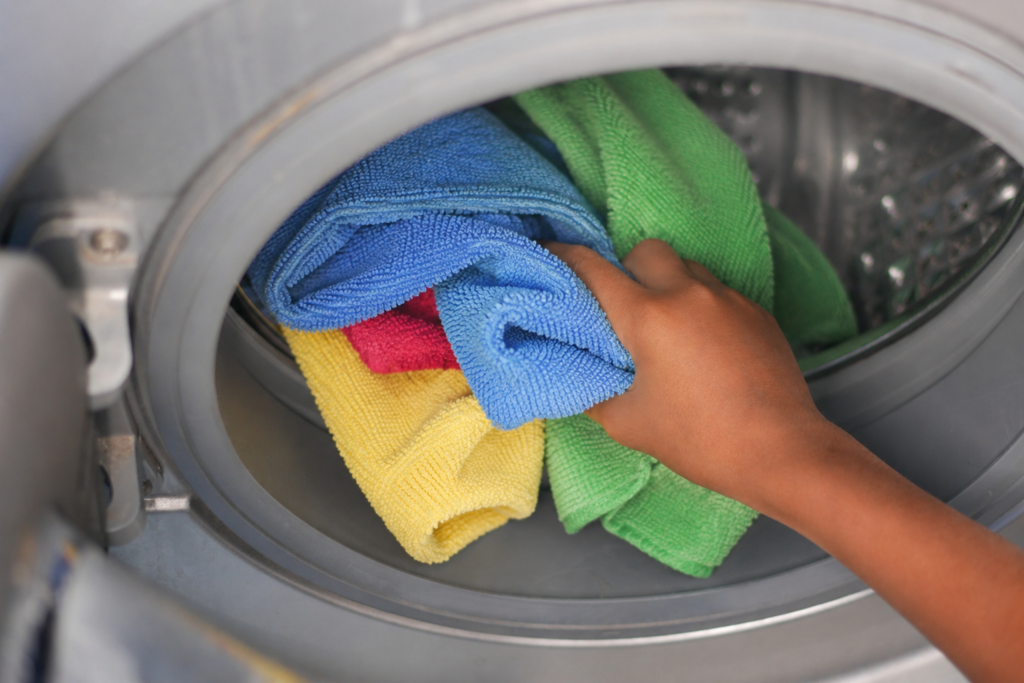
Microfibre cloths and mops are indispensable in professional cleaning. They remove soil effectively, support efficient cleaning methods and form an important part of many cleaning systems.
However, washing microfibre involves more than selecting a laundry programme. After use, microfibre cloths and mops must not only be washed; the process must also be shown to leave them clean and, where required, disinfected.
Setting a washing programme to 60, 70, 80 or 90°C is not the same as establishing that the material has reached that temperature, for long enough and under the correct process conditions. In this article, we explain what a professional microfibre laundry process should achieve and how its performance can be assessed objectively.
Washing microfibre cloths and mops: key considerations
Microfibre materials generally consist of very fine synthetic fibres, often polyester combined with polyamide. This fine fibre structure creates their well-known cleaning properties: soil and moisture are captured and retained within the material’s large surface area and fine structure.
At the same time, this structure makes microfibre sensitive to an incorrectly designed washing process. Detergent or cleaning chemical residues, unsuitable detergents and excessively high drying temperatures can negatively impair the performance and service life of microfibre materials.
Important considerations when washing microfibre cloths and mops include:
- Sufficient pre-rinsing and post-rinsing to ensure that loosened soil and detergent residues are effectively removed.
- Avoiding substances that may damage the fibre structure or reduce cleaning performance, such as fabric softener, fatty-acid soaps and bleaching agents.
- Maintaining a controlled drying process, as excessive temperatures can damage the fibres and reduce their functional lifespan.
Choosing the right cleaning materials, washing machine and laundry chemicals is important. However, a reliable outcome is only achieved when the entire process is properly controlled.
Cleanliness and disinfection are different requirements
When assessing a washing process for microfibre cloths, disinfection at a temperature of at least 60°C is often the first requirement mentioned. That is understandable: microfibre cloths and mops are used to clean a wide range of surfaces and must not become a source of cross-contamination during cleaning.
Nevertheless, disinfection is only one part of the desired result.
A process may perform adequately from a microbiological perspective while still falling short if visible or invisible soil is not removed sufficiently. During use, microfibre materials are exposed to dust, skin flakes, grease, organic contamination and other particles. These contaminants must be washed out of the material; temperature alone is not enough.
A good microfibre laundry process should therefore answer at least two questions:
- Are soil, detergent residues, cleaning chemical residues and other contaminants effectively removed from the microfibre material?
- Can it be demonstrated that the required microbiological reduction has been achieved?
A short or water-saving cycle may appear efficient, but it does not automatically provide sufficient time, mechanical action and rinsing stages for heavily used mops and cloths. Effective rinsing is particularly important for microfibre, as it helps preserve the material’s cleaning performance.
Measuring temperature during the microfibre laundry process
In practice, we regularly see assessments of a laundry process stop at the programme selection: “The washing machine is set to 60°C.”
That alone does not provide enough information.
The temperature shown on the display or selected in the programme does not always match the actual temperature inside the drum or within the textiles. The amount of time that the laundry remains at or above the required temperature is also critical. In addition, loading size, water level, detergent dosage and the sequence of rinsing stages all influence the final result.
For thermal disinfection, therefore, it is not simply one temperature value that matters. What is required is a demonstrable combination of time and temperature.
Temperature logger for washing machines
Anyone who wants to know how a microfibre washing process actually performs needs to measure the temperature inside the machine or have it measured. This usually cannot be done with a simple thermometer. Taking a water sample from the machine is often impractical, while measuring the outside of the drum provides insufficient insight into the temperature experienced by the textiles during the cycle.
A calibrated temperature logger provides a practical solution. The logger can be washed together with the load and records the temperature throughout the entire wash programme. The resulting data provide objective evidence of:
- Whether the required temperature is reached.
- How long the process remains at or above the relevant temperature.
- Whether the time-temperature profile supports the intended thermal disinfection performance.
- Whether variations occur between machines, programmes or load sizes.
This information provides significantly more certainty than a programme setting or verbal confirmation alone. It enables targeted improvements based on measured data rather than assumptions.
Demonstrating disinfection at lower washing temperatures
Laundry technology continues to evolve. New washing processes can achieve good disinfection results at lower temperatures, potentially creating opportunities to reduce energy consumption.
At the same time, the disinfecting performance of such processes can no longer be assessed solely on the basis of the measured temperature. It becomes especially important to establish whether the intended microbiological reduction has actually been achieved.
That is why CCD evaluates these processes using our DES Controller. This enables us to assess the microbiological performance of the laundry process and determine whether the intended microbial reduction has been achieved. Combined with temperature monitoring, it provides a complete picture of process’s performance.
Validating the microfibre laundry process
A reliable microfibre laundry process involves more than a washing machine, a programme and a dryer. The procedures for handling soiled and clean textiles, machine loading, chemical dosing, rinsing stages and the risk of recontamination after washing all affect the final result.
CCD is increasingly asked to assess and validate microfibre washing processes objectively. We do not look at disinfection in isolation; we assess the entire process involved in washing microfibre cloths and mops.
Whether in an industrial laundry or an on-premise laundry within a hospital or healthcare facility, validation helps objectively demonstrat that the process performs correctly and consistently over time.
- Does the process achieve the intended time-temperature performance?
- Can it be demonstrated that the required level of disinfection is achieved?
- Are the materials rinsed sufficiently?
- Is the process reproducible and properly controlled?
A reliable microfibre process requires evidence
Cleaning with microfibre materials can only remain effective when the washing process for those materials is properly designed, controlled and verified.
Assuming that a washing programme works simply because it was set up that way in the past is not process control. Process control means measuring, assessing and, where necessary, optimising the process.
Would you like to know how your washing process for microfibre cloths and mops performs? Contact CCD for a no-obligation discussion about the available options.


