MRSA, Staphylococcus aureus and laundry processes: why testing log reduction and BPA dipslides is critical for textile hygiene
In deze blog:
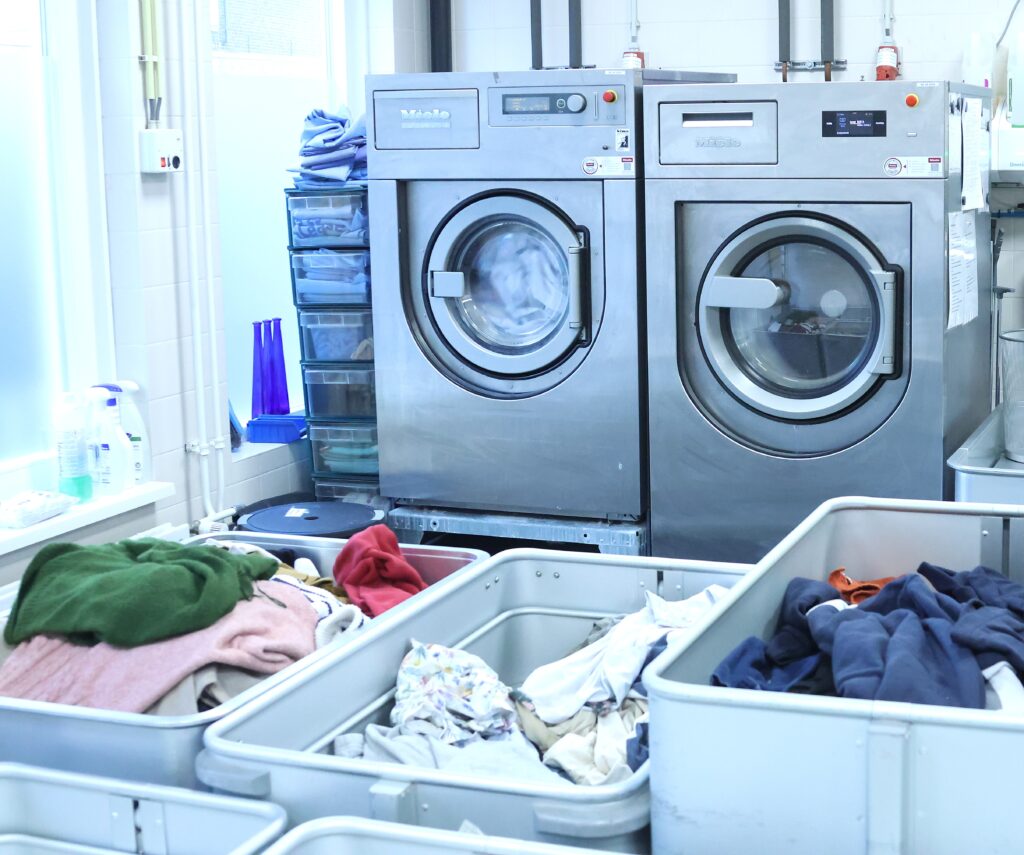
MRSA infections and outbreaks are receiving increasing attention in the Netherlands, particularly among residents of reception centres and people who have recently been admitted to healthcare facilities abroad. At the same time, safe textile hygiene is high on the agenda of healthcare organisations and professional laundries: bed linen, clothing and towels must not become a source of antibiotic-resistant bacterial transmission.
In this blog, we explore the relationship between MRSA and Staphylococcus aureus, how log reduction works in laundry processes, and the role that process validation with bio‑indicators (DES‑controllers) and hygiene monitoring with dipslides or contact plates on Baird Parker Agar (BPA) play in controlling risks associated with textiles.
MRSA and Staphylococcus aureus: the microbiological basics
Staphylococcus aureus is a common skin bacterium that many people carry on their skin and in their noses, often without any symptoms. Under certain conditions, however, this bacterium can cause infections, for example in wounds, at intravenous lines or in people with weakened immune systems.
MRSA stands for methicillin‑resistant Staphylococcus aureus: it is S. aureus that has become insensitive to a number of commonly used antibiotics. The bacterium itself belongs to the same species, but with an additional property – antibiotic resistance – that makes infections harder to treat.
When it comes to laundry, a crucial point is that MRSA and other S. aureus strains behave in the same way under the physical and chemical conditions encountered during laundering (temperature, mechanical action, detergent chemistry). The resistance relates to antibiotics, not to heat or standard detergent conditions.
For evaluating laundry processes, this is a key starting point: once you understand that MRSA is a variant of S. aureus, you can use S. aureus as a relevant indicator organism to objectively measure how effective your laundry process is against this group of bacteria.
Textiles as a transmission route in care and reception settings
In healthcare and reception settings, the risk of transmitting micro‑organisms is increased. Residents and clients frequently have skin and hand contact with their environment and with textiles. Typical examples include:
- Bed linen and duvets
- Personal clothing and workwear
- Washcloths and towels
- Pillowcases and incontinence products
When residents carry S. aureus or MRSA, these bacteria can be transferred to textiles. If dirty laundry is not managed safely, if logistics between clean and dirty textiles are insufficiently separated, or if the laundry process itself is not effective enough, textiles can become a source of transmission.
The question “Is my laundry process safe enough?” is therefore not a detail, but a core question within infection prevention.
Log reduction: what does a 10⁶ or 10⁷ reduction mean in a laundry process?
To objectively assess the effectiveness of disinfection during a laundry process, log reduction is often used as a measure of bacterial reduction. This compares the number of viable bacteria before and after the process.
- A 1 log reduction means 10 times fewer bacteria
- A 3 log reduction means 1,000 times fewer bacteria
- A 6 log reduction means 1,000,000 times fewer bacteria
- A 7 log reduction means 10,000,000 times fewer bacteria
In practice, a 6 log reduction corresponds to a 99.9999% reduction of the bacteria present. A 7 log reduction means that 99.99999% are demonstrably killed. For vegetative bacteria such as S. aureus, such high log reductions are regarded in standards and guidelines as levels that fit the definition of disinfecting processes.
Testing with bio‑indicators: moving from Assumptions to Process Certainty
Many organisations rely on temperature settings, programme duration, and detergent dosing to ensure textile hygiene. While these parameters are important, they do not prove what happens to micro‑organisms. True process certainty requires an extra step: objective and independent testing with bio‑indicators.
A DES‑controller for laundry processes is a unique bio‑indicator that, thanks to its semi‑permeable membrane, can be used completely safely and also prevents the measured reduction in micro‑organisms being due merely to wash‑off instead of actual microbial inactivation. The KT10‑STEF DES‑controller contains a standardised amount of Staphylococcus aureus on a test carrier. By washing this bio‑indicator together with a representative laundry load, you know:
- How much S. aureus is present before the process.
- How much survives after completion of the wash programme.
- Which log reduction the process achieves.
With regular, repeated measurements, it becomes clear whether the laundry process performs consistently well, including under varying load conditions. This provides far stronger evidence than simply reading the programme settings or relying on the assumption that “we always wash at 60°C”.
Relevance for MRSA: what is the link?
Because MRSA is a variant of Staphylococcus aureus, it is logical in situations with increased MRSA risk to use S. aureus – alongside other indicator organisms – as a key test organism when assessing laundry processes. It is then essential to be precise about what the measurements do and do not show.
- A demonstrated 10⁶ or 10⁷ log reduction of S. aureus on textiles shows that the laundry process achieves a very high level of bacterial reduction for this species.
- Because MRSA does not have fundamentally different survival characteristics during laundering compared to other S. aureus strains, it is reasonable to assume that the process is also highly effective against MRSA on textiles.
- This supports the conclusion that a validated laundry process which repeatedly achieves such reductions in Staphylococcus aureus makes an important contribution to reducing MRSA load on laundry.
At the same time, it is important to acknowledge that MRSA control is much broader: screening, isolation measures, hand hygiene, antibiotic stewardship, and environmental cleaning all play a role. Laundry process validation is one crucial link in that chain, not the only measure.
BPA dipslides: targeted monitoring of S. aureus in practice
Process validation with a DES‑controller shows how the laundry process performs. In daily practice, you also want to verify whether Staphylococcus aureus is truly absent or effectively controlled at critical points. For that purpose, dipslides with Baird Parker Agar (BPA) are suitable.
Key points:
- Baird Parker Agar is a selective growth medium developed specifically for detecting Staphylococcus aureus.
- With a BPA dipslide you can sample a surface, water sample or other process‑related location. After incubation, typical S. aureus colonies can be identified.
- Dipslides are a practical tool for quality managers who want to monitor the hygiene status of rooms, equipment, and contact surfaces.
In the context of textile hygiene and laundry processes, this means that you can:
- Use the DES‑controller to assess the bacterial reduction achieved by the laundry process against S. aureus.
- Use BPA dipslides to check whether unwanted S. aureus growth is occurring in the environment around the laundry process or at relevant contact points.
This creates a combination of process validation and practical hygiene monitoring.
Practical use as part of hygiene assurance and MRSA outbreak control
For laundries, healthcare organisations and reception centres, this microbiological framework means that, when aiming to safeguard hygiene and reduce MRSA outbreak risks, it is useful to:
- Periodically evaluate laundry processes with bio‑indicators such as the DES‑controller, to map log reduction on S. aureus.
- Take BPA dipslide samples at selected points in the chain (for example machine doors, folding tables, linen storage areas, or other high‑risk locations) to monitor the absence or control of Staphylococcus aureus.
- Link the results to infection prevention policies and contractual agreements with healthcare clients.
This way, you gain insight not only into what your laundry process is supposed to do, but also into how hygiene is demonstrably safeguarded in practice.
Bringing your laundry performance and hygiene status clearly into view
Would you like to know whether your laundry process achieves a safe log reduction of Staphylococcus aureus, and how you can practically monitor hygiene further down the chain?
- With DES‑controllers we can map, under controlled conditions, the log reduction your laundry process achieves.
- With BPA dipslides you can specifically check for the presence of S. aureus at relevant measurement points in your environment.
- Together, these tools help you to objectively assess textile hygiene and support your efforts to control MRSA‑related risks.
Contact us for an exploratory discussion about process validation and hygiene monitoring, visit our product pages for more information about available DES‑controllers and BPA dipslides, or consider involving our infection prevention specialist to take a broader look at the measures in place within your organisation.


